 ChatGPT
 Google AI
 Claude
 Perplexity
Best Performance Marketing Agency Bangalore in 2026
Updated on
March 23, 2026
March 23, 2026
Read summarized version with
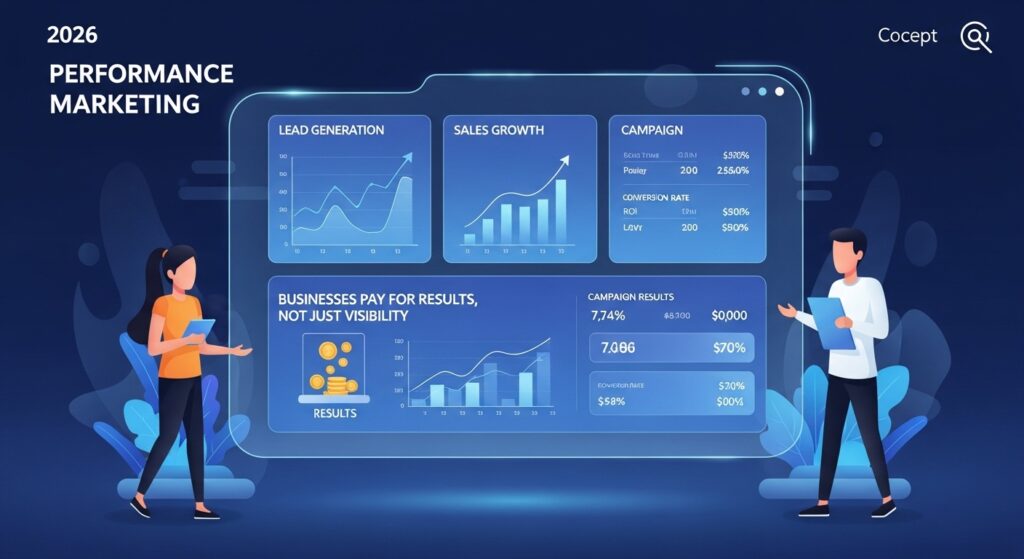
In simple terms, performance marketing in 2026 means that running marketing businesses will focus more on “paying for results instead of visibility.” In essence, businesses will not focus their marketing strategies on “paying to advertise” but instead will “pay for what’s real.” This makes marketing not only simpler but also more efficient.
For leaders, this means that they will not have to wonder what works and what doesn’t. They will have a clear idea of what drives their business to generate more leads, what drives their business to make more sales, and what drives their business to require more funds.
Here are some enlightening numbers that help illustrate why performance marketing is so attractive to businesses:
What these numbers show is that there is a definite shift in the way that marketing is thought about. Rather than asking, “How many people saw our ads?” marketers are now asking, “How many leads or sales did our marketing produce?”
Marketing in today’s world is not the same as it used to be in the past. Consumers behave in a different manner, and the rules for digital platforms have changed.
Three important changes that are currently influencing marketing:
1) Privacy is more important than ever
Less personal information is being gathered by platforms. Agencies focus on website data and clear tracking to measure success.
2) Companies use multiple platforms together
The best marketing campaigns involve more than one platform. Companies combine search, social, display, and email to target consumers.
3) Consumers demand faster and clearer experiences
Customers demand relevant offers and fast answers. Companies that provide clear messages and simple actions attract more customers.
Due to these changes, pay-for-performance marketing has emerged as the most popular marketing strategy for companies seeking measurable growth.
Many people assume marketing success comes from creativity alone. Creativity is important, but strong campaigns follow a clear process. Understanding how marketing works helps businesses know what to expect from an agency.
Every campaign begins with a clear goal.
Common goals include:
Without a clear goal, results are difficult to measure.
The next step is choosing the right people to show ads to.
Agencies consider factors such as:
Showing ads to the right audience increases the chance of strong results.
People respond best to simple messages.
Agencies focus on:
The goal is to encourage visitors to take the next step.
Different channels help at different stages of the buying process.
Common channels include:
Combining channels often produces better results than relying on just one.
Tracking shows how we figure out which actions led to a sale.
Agencies measure indicators such as:
These numbers show where campaigns perform well and where improvements are needed.
Strong campaigns grow through testing and learning.
Agencies focus on:
Even small improvements can produce large gains after several months.
Business leaders need clear insights.
Reports should answer three simple questions:
How much money is returned for every dollar spent on ads?
Many leaders want a clear and simple answer before they bring an agency on board: Does it really work? The fact is, across different sectors, companies that make the move to measurable marketing campaigns experience real benefits in terms of lead generation, sales efficiency, and brand exposure. The figures below highlight the benefits that companies can reap from running structured performance campaigns with experienced marketing professionals within their own team.
| Marketing Indicator | Typical Business Before | After Structured Performance Marketing |
| Leads generated per month | 40–60 leads | 80–120 leads |
| Cost per result | ₹2,000–₹3,000 | ₹1,200–₹1,800 |
| Percent of visitors who take the desired action | 2–3% | 4–6% |
| Money returned for every dollar spent on ads | 2x return | 4x–6x return |
| Campaign visibility across channels | 1–2 channels | 3–5 channels |
While the numbers will vary depending on the industry, the pattern will remain the same: more leads, lower costs, and better results when campaigns are designed with performance in mind.
What you can expect from typical deliverables
What metrics should decision-makers focus on to make the right decision for improvements they make, with a few key points to keep in mind:
These results are connected to marketing efforts and directly to the business results shown.
Quick checklist for selecting the right agency for the business
Before you make a decision, ask the following:
Different channels support different goals. The table below shows how businesses commonly use them.
| Channel | Best For | Example Business Goal |
| Search Ads | High-intent buyers | Generate leads from people searching for services |
| Social Media Ads | Discover new audiences | Promote new products or offers |
| Display Ads | Brand visibility | Build awareness for new brands |
| Retargeting Ads | Bringing visitors back | Convert website visitors into customers |
| Email Marketing | Nurturing prospects | Build long-term relationships with leads |
Performance marketing has proven to be one of the most reliable ways for a business to expand. Not only from a theoretical standpoint, but it’s also doable. It connects marketing work to generate the leads and performance of the site and brings sales and actual revenue.
Remember how marketing used to work? Businesses invested in marketing and hoped for the best.
Performance marketing turned the equation around.
When you have a clear set of objectives and perfect reach to the right people, have compelling messaging, and focus on continuous improvement, marketing begins to feel different. More predictable. More controllable. Almost like a growth engine that just keeps getting better and better.