 ChatGPT
 Google AI
 Claude
 Perplexity
Swiggy Instamart vs. Your Own Instagram Store: What Actually Works for Early-Stage F&B Brands
Updated on
May 29, 2026
May 29, 2026
Read summarized version with
For brands stepping into the world of nutraceuticals, pharmaceuticals, or the wellness industry, manufacturing takes precedence in terms of decision making. Brand quality, scalability, compliance, and consistency will all have to be strong for the company to get into this industry as a manufacturing partner. So it is common for those who are looking for outsourcing manufacturing to third party companies in India, so they can focus on branding and sales.
But not every manufacturing partner can bring similar expertise to the table. While some might offer good research and development capabilities along with regulatory expertise, there are others who will just manufacture your product. In our work with health and supplements brands on their digital transformation journey, we found out that a proper manufacturing partner determines how well a brand can scale. There are a few things you must take into consideration before entering into any partnership agreement.
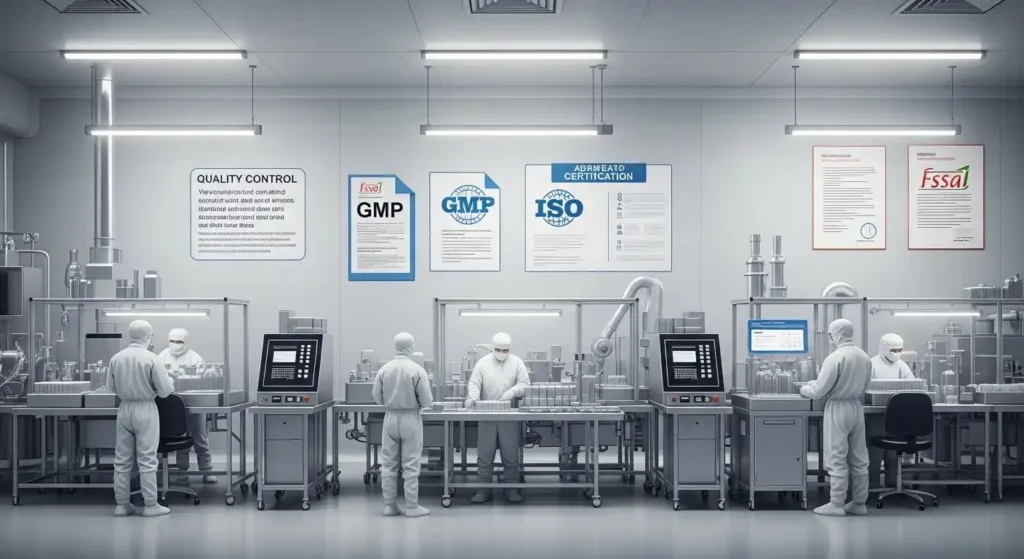
The first thing most brands notice when choosing a manufacturing partner is compliance. Certifications. They matter more than people think. It’s not just paperwork. They show how the factory actually operates inside. When the product category is health, nutraceuticals, or supplements, the importance of the standards increases. Quality control. Hygiene. Process discipline. All of it directly affects the final product that reaches the customer. Usually, the conversation starts with certifications like GMP, ISO, and FSSAI. These are signals. They indicate the manufacturer follows a structured production system. Proper documentation. Controlled manufacturing environments. Defined quality checks. Not perfect always. But it shows the process exists.
In most cases, a reliable Third-Party Manufacturing Company in India will be open about these details. They share documentation. Explain their compliance process. Sometimes, they even walk you through their quality procedures. And honestly, that is where trust begins. Simple step. Ask for the certificates. Review the documents. Understand how their quality system actually works before moving forward.
Every brand enters the market a little differently. Some start simple. Capsules. Tablets. Easy formats. But growth changes things. Consumer preferences shift. Suddenly there is interest in powders, gummies, maybe effervescent tablets. Sometimes even liquid supplements.
This is where manufacturing flexibility quietly becomes important. Not every facility can support multiple formats. Some specialize in just one or two. Others have broader production capabilities. That difference shows up later when a brand wants to expand.
When reviewing a manufacturer, it helps to look at what formats they already produce amd what type of the products are getting highlighted we can understand. Capsules, powders, tablets, gummies, liquids. The ease of expanding a product increases with its capability. No need to change partners halfway through growth.
Technology also plays a role in this industry. Automated production lines. Modern filling systems. Efficient packaging setups. Manufacturers investing in updated equipment often deliver more consistent batches and faster turnaround.
Innovation is one of the important competitive advantages in this market sector. Several popular companies are able to distinguish themselves from others through formulation innovations, blends, and clinically tested ingredients. And here the technical assistance of R&D department plays an important role. A professional Third-Party Manufacturing Company from India has an experienced formulation department which is ready to create a unique formulation for your new supplement.
Besides developing new formulas, R&D department can work on the source of ingredients, correct dosage of active components, flavor development, and shelf life of products. For start-up brands, this professional support is able to shorten the time needed to develop new products.
Often, many brands begin their journey with smaller batches in terms of production or based on the supply demand. However, when demand rises, it is crucial to improve the production capacity in manufacturing. Those with smaller production capacities could face problems in handling large order quantities and the supply of the product, which will affect the branding of the firm. Hence, it is essential to assess the production capacity of the manufacturers in terms of production facility sizes, production lines, and batch capacities.
Having a scalable manufacturer will make sure that your brand does not face difficulties in increasing its batch production volume. It is also instrumental in ensuring a consistent supply during marketing campaigns and distributor relationships. Selecting a scalable manufacturer will allow your brand to progress smoothly without facing any operational issues.
Since such partnerships tend to be long-term, it is also necessary to note how important it is to communicate and stay transparent throughout. The good manufacturer will provide you with accurate production time frames, from the very start of manufacturing and testing to shipping. It will keep an open line of communication as far as raw material sourcing and the possible delay in production are concerned.
Having a structured and organized manufacturer on your hands makes everything much easier. You will be able to plan your marketing activities, product release, etc. From our experience, the most successful collaborations we have witnessed were always with manufacturers who communicated well and had set processes in place.
As soon as brands begin to shortlist their manufacturing partners, it becomes important for them to analyze the whole situation through the prism of comparative analysis. Instead of assessing all aspects haphazardly, using the approach of comparative analysis will help the team reach sound business decisions.
A great number of brands that plan to collaborate with the Third-Party Manufacturing Company in India make use of such comparative analysis while assessing the company.
| No. | Critical Factor | Key Questions to Ask | What Strong Manufacturers Usually Offer |
| 1 | Regulatory Compliance | Are GMP, ISO, and FSSAI certifications valid and up to date? | Fully certified facilities with documented quality control systems. |
| 2 | Product Development Capability | Can they help with formulation, ingredient sourcing, and testing? | Dedicated R&D teams and formulation experts. |
| 3 | Product Format Flexibility | Do they manufacture capsules, powders, tablets, or liquid supplements? | Multiple production formats and packaging options. |
| 4 | Production Infrastructure | How large is the facility and how many production lines are available? | Scalable production lines that support higher batch volumes. |
| 5 | Operational Transparency | How clear are their timelines, documentation, and communication processes? | Structured workflow, regular updates, and organized documentation. |
The selection of the right Third-Party Manufacturing Company in India plays a vital role in success in the nutraceutical, wellness, or healthcare industry. Such a selection is very crucial since the company selected would determine the quality of products, scalability, and reliability of a particular brand in the market.
Pricing and speed of availability should not be the only considerations when selecting a manufacturing partner. Other factors such as certifications offered, manufacturing capacities, Research and Development facilities provided, scalability, and other aspects that can make sure a brand grows should be considered as well.
Often, when brands are successful in the nutraceutical industry, it happens because of collaborations with manufacturing partners who share similar business visions. With a reliable system of communication and quality standards set, it becomes easy for any brand to grow in the market.